
Transcribing a Cursive Civil War Diary — Every Faded Page
Richard Melvin set out to digitize the diaries his great-grandfather kept from 1861 to 1913 — more than 6,300 scans. After trying several cursive-to-text converters, he chose Pen to Print. This is his story.
Try it on your own handwriting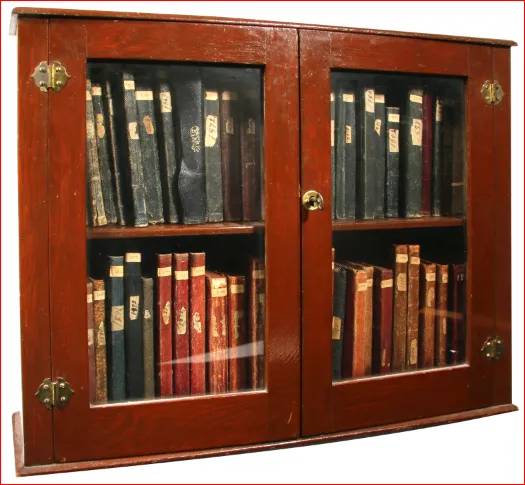
Richard Melvin's great-grandfather, Samuel Jones Melvin, began his diary on January 1, 1861, and kept writing an entry almost every day until the spring of 1913 — recording an ordinary working life, and his tour of duty in the Union Army during the American Civil War. He died in 1913 at the age of 74; his final entry breaks off mid-sentence, never finished.
He kept the diaries in small booklets. To preserve them, Richard digitally photographed every single page: more than 6,300 images. A portion had been transcribed by hand years ago. The rest remained locked inside 160-year-old cursive handwriting. Until now.
It's not hard to see why. The ink has grown faint over the decades — on spreads like the April 1867 one shown here, the entries for the 7th, 8th, and 9th have all but vanished, barely visible to the naked eye. And even where the writing holds up, the sheer volume is daunting: thousands of pages that would take years to transcribe manually.
Pen to Print was built for exactly this. Our advanced image processing lifts words off pages that have nearly faded from view — turning near-illegible entries into clean, editable text. And our Cursive Reader specializes in the handwriting itself — deciphering cursive that others just can't read.
Learn about our Cursive Reader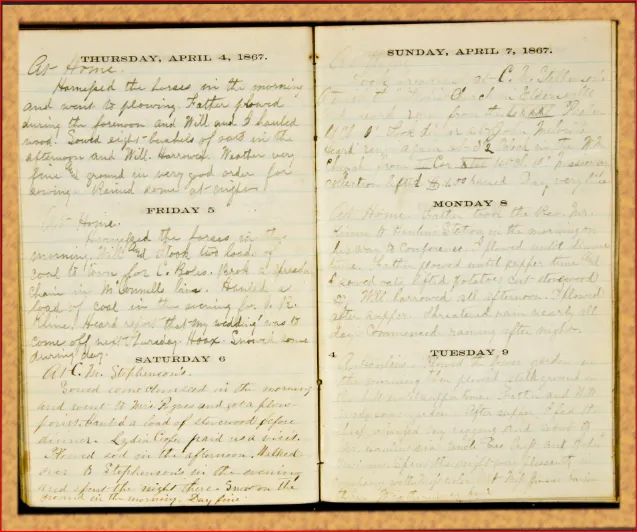
“I chose your app after trying about a dozen different cursive to text online converters. Yours handle this difficult task much better than any other app I tried. And I really mean "difficult." … Even though pages like this are barely readable with the naked eye, your app was able to provide editable text that was about 95% correct. I only had to make a handful of corrections on this page. My thanks to the developers of this app. They have done a great job!”
For a project this size, Richard uses our desktop app to batch-convert hundreds of pages at a time. On pages barely readable with the naked eye, he reported about 95% accuracy — leaving only a handful of corrections per page. Where the ink had survived, he estimated closer to 99%, and the few remaining errors were usually spots where his great-grandfather's own handwriting was unclear.
“I've processed several thousand images so far from the old diaries I'm working on. I am finding the app to be extremely accurate and easy to use.”
The transcriptions are going straight into his family archive — preserving the diaries for the next generation. You can follow the pages he's building here:
The Transcribed Diaries of Samuel Jones MelvinHave a great story of your own? Tell us
Have Handwriting That Other Tools Can't Read?
Cursive, faded ink, century-old documents — the harder the handwriting, the more Pen to Print stands out.

Cursive Reader: Translate Cursive to Text
Convert cursive, messy, and illegible handwriting into clear, readable digital text.
Read more
Digitize and Archive Handwritten Documents and Records
Convert letters, journals, and records into searchable digital text.
Read more